Trinity 5 / Pentecost 6
Sunday, 05/07/2026

SENTENCE FROM SCRIPTURE:
Grace flows from your lips, because God has blessed you for ever. (Psalm 45)
GREETING
Grace and peace to you from God our Father
and the Lord Jesus Christ. Amen
COLLECT FOR PURITY
Almighty God,
to whom all hearts are open,
all desires known,
and from whom no secrets are hidden:
cleanse the thoughts of our hearts
by the inspiration of your Holy Spirit,
that we may perfectly love you,
and worthily magnify your holy name;
through Christ our Lord. Amen.
SUMMARY OF THE LAW
Our Lord Jesus Christ said: The first commandment is this:
Hear, O Israel, the Lord our God is the only Lord. You shall love the Lord your God with all your heart, with all your soul, with all your mind and with all your strength.”
The second is this: “Love your neighbour as yourself.” There is no other commandment greater than these. Amen. Lord, have mercy.

CONFESSION AND ABSOLUTION
God is love and we are God’s children. There is no room for fear in love. We love because God loved us first.
Let us confess our sins in penitence and faith.
SILENCE
God our Father,
we confess to you
and to our fellow members in the Body of Christ
that we have sinned in thought, word and deed,
and in what we have failed to do.
We are truly sorry.
Forgive us our sins,
and deliver us from the power of evil,
for the sake of your Son who died for us, Jesus Christ, our Lord.
ABSOLUTION
God, who is both power and love,
forgive you and free you from your sins,
heal and strengthen you by the Holy Spirit,
and raise you to new life in Christ our Lord. Amen.
GLORIA sung by Sue St Joseph
COLLECT
O Lord,
let the world be ordered in peace,
according to your will:
that your people may be free to worship you with joy;
through Jesus Christ, our Lord,
who lives and reigns with you,
in the unity of the Holy Spirit,
one God, world without end. Amen
PROCLAIMING & RECEIVING GOD’S WORD
FIRST READING Genesis 24.34–38, 42–49, 58–67, read by Gill Swales
The servant whom Abraham had sent said to Laban: 34 ‘I am Abraham’s servant. 35 The LORD has greatly blessed my master, and he has become wealthy; he has given him flocks and herds, silver and gold, male and female slaves, camels and donkeys. 36 And Sarah my master’s wife bore a son to my master when she was old; and he has given him all that he has. 37 My master made me swear, saying, “You shall not take a wife for my son from the daughters of the Canaanites, in whose land I live; 38 but you shall go to my father’s house, to my kindred, and get a wife for my son.”

42 I came today to the spring, and said, “O LORD, the God of my master Abraham, if now you will only make successful the way I am going! 43 I am standing here by the spring of water; let the young woman who comes out to draw, to whom I shall say, ‘Please give me a little water from your jar to drink,’ 44 and who will say to me, ‘Drink, and I will draw for your camels also’ – let her be the woman whom the LORD has appointed for my master’s son.” 45 Before I had finished speaking in my heart, there was Rebekah coming out with her water jar on her shoulder; and she went down to the spring, and drew. I said to her, “Please let me drink.” ✝
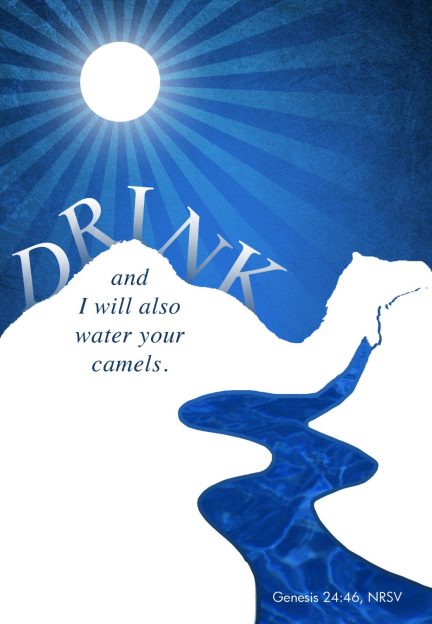
46 She quickly let down her jar from her shoulder, and said, “Drink, and I will also water your camels.” So I drank, and she also watered the camels. 47 Then I asked her, “Whose daughter are you?” She said, “The daughter of Bethuel, Nahor’s son, whom Milcah bore to him.” So I put the ring on her nose, and the bracelets on her arms. 48 Then I bowed my head and worshipped the LORD, and blessed the LORD, the God of my master Abraham, who had led me by the right way to obtain the daughter of my master’s kinsman for his son. 49 Now then, if you will deal loyally and truly with my master, tell me; and if not, tell me, so that I may turn either to the right hand or to the left.’ 58 And they called Rebekah, and said to her, ‘Will you go with this man?’ She said, ‘I will.’ 59 So they sent away their sister Rebekah and her nurse along with Abraham’s servant and his men. 60 And they blessed Rebekah and said to her, ‘May you, our sister, become thousands of myriads; may your offspring gain possession of the gates of their foes.’ 61 Then Rebekah and her maids rose up, mounted the camels, and followed the man; thus the servant took Rebekah, and went his way. 62 Now Isaac had come from Beer-lahai–roi, and was settled in the Negeb. 63 Isaac went out in the evening to walk in the field; and looking up, he saw camels coming. 64 And Rebekah looked up, and when she saw Isaac, she slipped quickly from the camel, 65 and said to the servant, ‘Who is the man over there, walking in the field to meet us?’ The servant said, ‘It is my master.’ So she took her veil and covered herself. 66 And the servant told Isaac all the things that he had done. 67 Then Isaac brought her into his mother Sarah’s tent. He took Rebekah, and she became his wife; and he loved her. So Isaac was comforted after his mother’s death.
SECOND READING Romans 7.15–25a, read by Kay Solaja
15 I do not understand my own actions. For I do not do what I want, but I do the very thing I hate. 16 Now if I do what I do not want, I agree that the law is good. 17 But in fact it is no longer I that do it, but sin that dwells within me. 18 For I know that nothing good dwells within me, that is, in my flesh. I can will what is right, but I cannot do it. 19 For I do not do the good I want, but the evil I do not want is what I do. 20 Now if I do what I do not want, it is no longer I that do it, but sin that dwells within me. 21 So I find it to be a law that when I want to do what is good, evil lies close at hand.
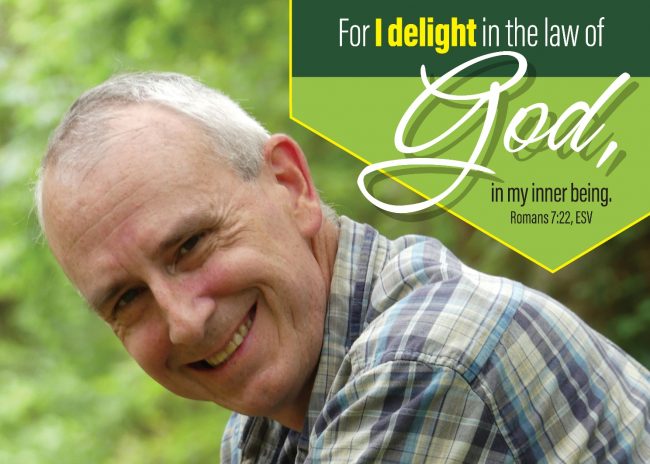
22 For I delight in the law of God in my inmost self, 23 but I see in my members another law at war with the law of my mind, making me captive to the law of sin that dwells in my members. 24 Wretched man that I am! Who will rescue me from this body of death? 25 Thanks be to God through Jesus Christ our Lord!
GRADUAL HYMN
GOSPEL Matthew 11.16–19, 25–30; read by Steven Ballard
https://youtube.com/shorts/VUCd_M32AJc
Hear the Gospel of our Lord Jesus Christ according to Matthew, Chapter 11, beginning at verse 16
Glory to Christ our Saviour
16 ‘To what will I compare this generation? It is like children sitting in the market-places and calling to one another, 17 “We played the flute for you, and you did not dance; we wailed, and you did not mourn.” 18 For John came neither eating nor drinking, and they say, “He has a demon”; 19 the Son of Man came eating and drinking, and they say, “Look, a glutton and a drunkard, a friend of tax-collectors and sinners!” Yet wisdom is vindicated by her deeds. 25 I thank you, Father, Lord of heaven and earth, because you have hidden these things from the wise and the intelligent and have revealed them to infants; 26 yes, Father, for such was your gracious will. 27 All things have been handed over to me by my Father; and no one knows the Son except the Father, and no one knows the Father except the Son and anyone to whom the Son chooses to reveal him.
28 Come to me, all you that are weary and are carrying heavy burdens, and I will give you rest. 29 Take my yoke upon you, and learn from me; for I am gentle and humble in heart, and you will find rest for your souls. 30 For my yoke is easy, and my burden is light.’
Give thanks to the Lord for his glorious Gospel
Praise to Christ our Lord.
SERMON
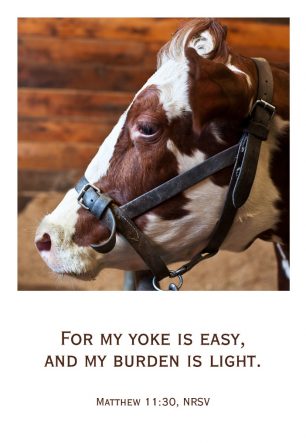
I well recall the first time I ever saw a farmer ploughing the land with oxen yoked together. This was in the region the New Testament describes as Samaria, when we were journeying from Galilee to Jerusalem on pilgrimage. The most basic yokes are made of wood rather than iron. Palestine in Jesus’ day was an agricultural society, and there must have been a high demand for wooden products. Jesus himself was a carpenter, who followed in the trade of his father, Joseph, and there was a legend that he made the best yokes in Galilee.
In the Gospel reading for today, Jesus says, “Take my yoke upon you and learn from me, for I am gentle and humble in heart, and you will find rest for your souls. For my yoke is easy, and my burden is light.”
Today’s reading from St Matthew’s Gospel contrasts with what we’ve been hearing Jesus say lately. For most of the last few weeks, Jesus has been talking about the cost of discipleship. He has spoken about the certainty of persecution and conflict. Discipleship involves hard choices and can result in suffering and painful division for those who choose to follow him. “Leave it all behind, take up your cross, give up your life for my sake.” Strong words like that.
Today, though, Jesus’s tone changes. He promises rest and comfort, light burdens and easy yokes. This is more like it. Gentle teachers are much more to our liking, but Jesus’ words are more complex than they seem.
First, the primary thrust of what Jesus is saying here is not directed toward people who have just any kind of difficulty. By “all you that are weary and are carrying heavy burdens,” Jesus doesn’t, at least not in the first instance, mean people with ordinary problems – the type of problems people so often face in our own day. Common problems nowadays might include having too many bills, being unemployed or sick, having children who have gone off the rails, a hard life, or whatever. Here, Jesus is speaking quite specifically to those on a religious quest – those who are seeking God and a relationship with God. He is calling to himself those who are spiritually exhausted – those who, as Paul was just saying about himself in today’s extract from his letter to the Romans, have tried all the usual ways of finding peace with God.
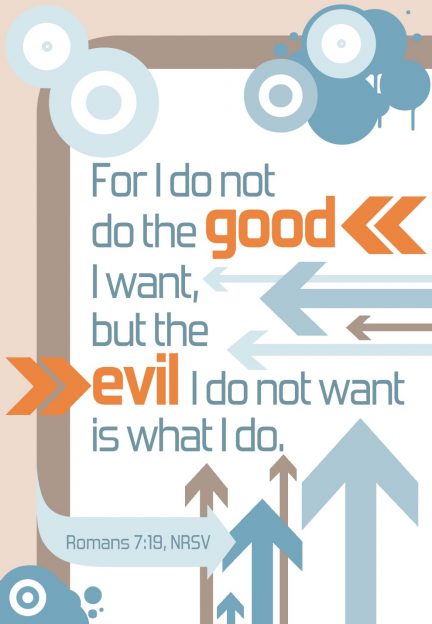
In our second scripture reading, the apostle speaks of the dilemma at the heart of every person who seeks to be totally Christlike in their life. Paul, as the Pharisee Saul, had tried to become righteous by keeping the law and earning salvation that way; he was his own worst taskmaster. He had attempted perfection and knew he was failing. And now he had experienced something similar in his new Christian life. Laying his soul on the line, he wrote, “For I do not do the good I once did, but the evil I do not want is what I do.” There was a huge difference now, though, because Paul knew that, despite his sinfulness, he was in a state of grace, and that, despite his failings, he had been set free and had now been saved through the death of Jesus on the Cross.
But let’s return now to Jesus’s saying. He talks here about taking up his yoke and finding rest for our souls. The real clue is that a yoke was the common symbol of the Law of Moses, especially for the details of the law and the minute, ever-expanding demands of the Pharisees’ legalism. In fact, this is the main way the rabbis used the word “yoke” allegorically.
The great problem with the Pharisees, although some of them were undoubtedly good and holy men, was that whilst they venerated the law of Moses, they tended to idolise it. This was a case of putting the cart before the horse. Instead of seeing the keeping of God’s law as a roadmap that offered principles for a right relationship with God, they had turned it into a stern and unforgiving taskmaster.
This is why Jesus said that the wise and intelligent – that is, the religious leaders – had missed the point. He then adds that only the Son – not those leaders, and not you, and not anyone else, only the Son – knows the Father.
The yoke of the Pharisees, their demands that you have to do this and that exactly right in order to be righteous before God, to be a decent person– that’s the yoke that Jesus rejects.
The yoke of getting into a right relationship with God by obeying all the rules, by trying to get it right all the time, and living constantly in fear of getting it wrong- that yoke leads to frustration and, worse still, to despair. It leads to a religion that is at the mercy of any number of petty dictates, in which the spirit is deadened. But there’s a flip side to the coin as well, where any successes we perceive we have attained are more likely to lead us into self-righteousness than into the heart of God.
To say to a child, or a friend, or a spouse, or anyone, really, “I will only love you if you do right,” is to ensure a damaged relationship. It hurts everybody involved.
To teach that God’s love is conditional on our own goodness isn’t just terrible theology; it can also be devastating. Yet the yoke of the Law, at its worst, did just that. Those who, like Paul, struggled under such a yoke discovered that it didn’t fit; that it didn’t bring them to God; that it didn’t enrich their lives. Yokes like that never do.
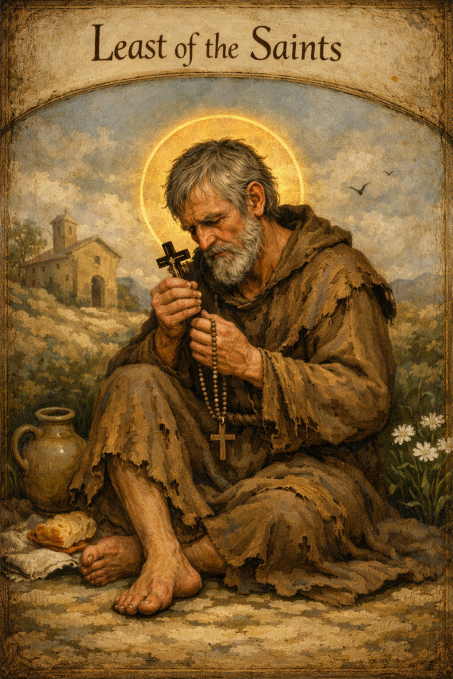
Created with Copilot
To drive ourselves to the point of exhaustion that if we could only figure out the right thing to do – the right way to act, the right words to say, the right way to do the rituals – then we would be all right, leads us to the state at which St Paul arrived before his conversion. He had kept the law to the letter, the most zealous Pharisee of all, and where had it got him? It had led him to hate and persecute the Church, and that is why St Paul refers to himself as the least of the saints.
In response to all of this, Jesus says, “Come to me.” We are called, in the first instance, not to do this or to do that, but to come to Jesus himself.
In essence, Jesus is saying, “If you seek God; if you seek his love; if you seek a life that makes sense; if you want a way of understanding the world that allows you to live in an authentic way and not end up by being emotionally and spiritually destroyed; if you want to be who you are created to be – if you want this, then come to me.”
It’s a call to relationship – to a relationship with Jesus. The alternatives, then and now, will fail. Jesus will not.

THE CREED
We believe in one God, the Father, the Almighty,
maker of heaven and earth,
of all that is, seen and unseen.
We believe in one Lord, Jesus Christ,
the only Son of God,
God from God,
Light from Light,
true God from true God,
begotten, not made,
of one substance with the Father.
Through him all things were made.
For us and for our salvation
he came down from heaven;
by the power of the Holy Spirit
he became incarnate of the Virgin Mary,
and was made man.
For our sake he was crucified under Pontius Pilate;
he suffered death and was buried.
On the third day he rose again in accordance with the Scriptures;
he ascended into heaven
and is seated at the right hand of the Father.
He will come again in glory to judge the living and the dead,
and his kingdom will have no end.
We believe in the Holy Spirit,
the Lord, the giver of life,
who proceeds from the Father.
With the Father and the Son,
he is worshipped and glorified.
He has spoken through the Prophets.
We believe in one holy catholic and apostolic Church.
We acknowledge one baptism for the forgiveness of sins.
We look for the resurrection of the dead, and the life of the world to come. Amen.

PRAYERS
For our response today, we’re using the refrain from today’s Psalm: Grace flows from your lips, because God has blessed you for ever.
Today we are giving thanks for God’s guidance of us by means of his word. Our Old Testament reading tells of Abraham’s servant being commissioned to find a wife for Isaac, and of his seeking, and following, God’s direction in his quest. We ask you, Sovereign Lord, to guide us at St John’s, thinking particularly of Vacancy Committee and Vestry, but in fact all of us, in the commissions and decisions we have, or will shortly have, before us; help us discern the right paths and take them; and may we, like Abraham’s servant, be able to say, ‘Praise the Lord…who has shown unfailing love and faithfulness, for he has led us straight.’